
Not in this cut: a problem/setup beat. The Sprint tests a problem-first opener against this product-first one.
Not in this cut: an offer. In a Sprint the offer (price, bundle, guarantee) is a test variable: a 1.5 s card swapped in before the end frame.
Beat boundaries sit on measured scene cuts (ffmpeg scene detection); ≈ marks one read from frames. The hook window is 0–1.5 s by definition. Click a beat to jump.
Built for sound-off.
This cut has no audio track: everything it says is on screen, which is how most of the feed watches it anyway.
- COMVITA
- Mānuka Honey
- UMF 10+ · MGO 263+
- Beekeeping since 1974
- Product of New Zealand
Brand legible by ~1.5 s (frames sampled every 0.5 s)
Spec · Comvita · Food
Honey, drawn as a C
Spec work · not commissioned by or affiliated with Comvita. Trademarks belong to their owners.Spec work · not commissioned by or affiliated with Comvita. Trademarks belong to their owners.
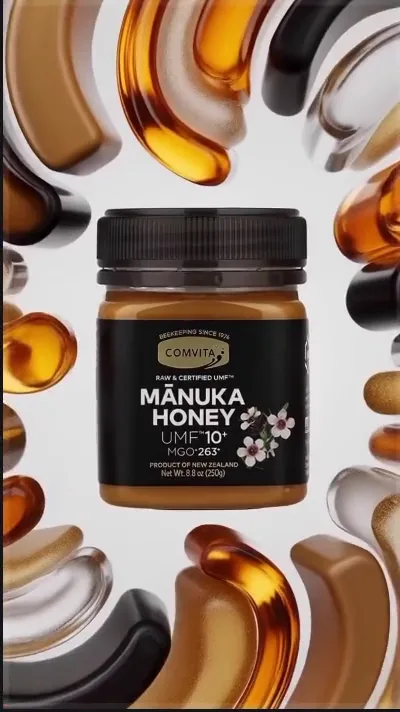
Honey, glass and black ribbons coil into the brand's C, open onto the jar, then stack into slow amber layers before the C closes the loop.
- Brand
- Comvita
- Product
- Mānuka Honey UMF 10+ MGO 263+
- Format
- Motion graphics
- Frame
- 9:16 · 9.7 s · silent cut
- Brand on screen
- by ~1.5 s (frames sampled every 0.5 s)
- Tools
- Made with Higgsfield · owner-supplied cut
01 · Brief
Comvita sells a graded, premium honey where the label numbers do the persuading. This cut keeps every label line legible (UMF 10+, MGO 263+, Product of New Zealand) and wraps them in a moving brand mark, so the premium reads without sound or voiceover.
02 · Hook: the thumb-stop
Frame one is the brand's C built from glossy honey, glass and black ribbons: the mark lands before the product does, and it moves.
03 · Angle
Brand-mark product reveal: the ribbons that draw the C wrap the jar, so the grade on the label (UMF 10+, MGO 263+) reads as part of the logo, not as small print.
04 · Structure, beat by beat
- Hook · 0.0–1.5 s
Honey ribbons curl into a C: the brand mark before the jar.
- Product + grade · 1.5–5.0 s
The jar lands among honey ribbons; the label carries the grading (UMF 10+ · MGO 263+) that Mānuka buyers check first.
- Texture · 5.0–8.0 s
Layered honey slabs in macro: thickness and colour as the quality cue.
- End card · 8.0–9.7 s
The ribbons close back into the C: logo lock-up end.
Not in this cut: an offer. In a Sprint the offer (price, bundle, guarantee) is a test variable: a 1.5 s card swapped in before the end frame.
Timings from measured scene cuts; ≈ = read from frames. Turn on Ad anatomy to watch the beats on the player.
05 · What we'd test first
- A
Opener: the C-swirl frame one against a jar-first frame one, judged on 3-second views per impression.
- B
Proof order: the UMF / MGO grade on the jar close-up against a grade-first super, judged on hold to the end and outbound click-through.
06 · What a Sprint does with it
- Thumb-stop first. The first 1.5 s decides whether anyone sees the rest. We cut three openers from this master and let the account pick, instead of arguing about taste.
- One master, many cuts. This master becomes the 9:16, 4:5 and 1:1 set in two lengths, captioned and named for your ad account, so testing velocity is limited by budget, not by edits.
- Ahead of creative fatigue. New hooks and angles land before frequency climbs on the winner, so the account is never waiting on the next shoot.
- Judged on CAC, not on likes. Each cut has a hypothesis and a kill rule; the day-21 read-out says which one lowered your cost per acquisition and which one lost.
07 · Three frames
20 % · 00:02 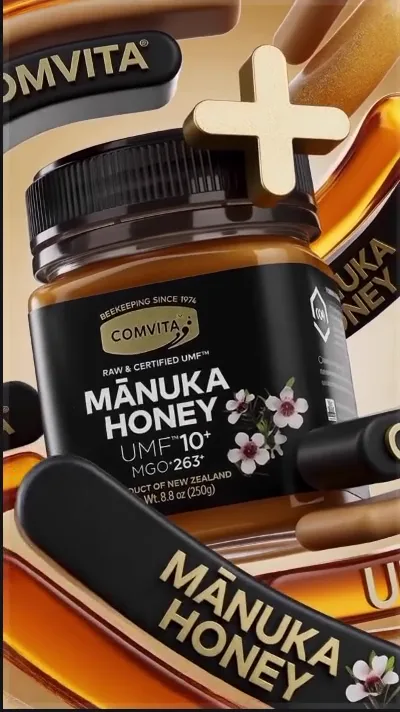
50 % · 00:05 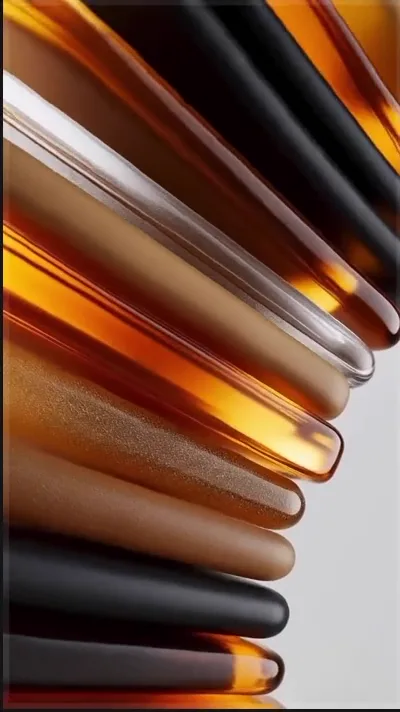
80 % · 00:08
Made with Higgsfield · owner-supplied cut
Brand owner? Email [email protected] and we'll take it down.